
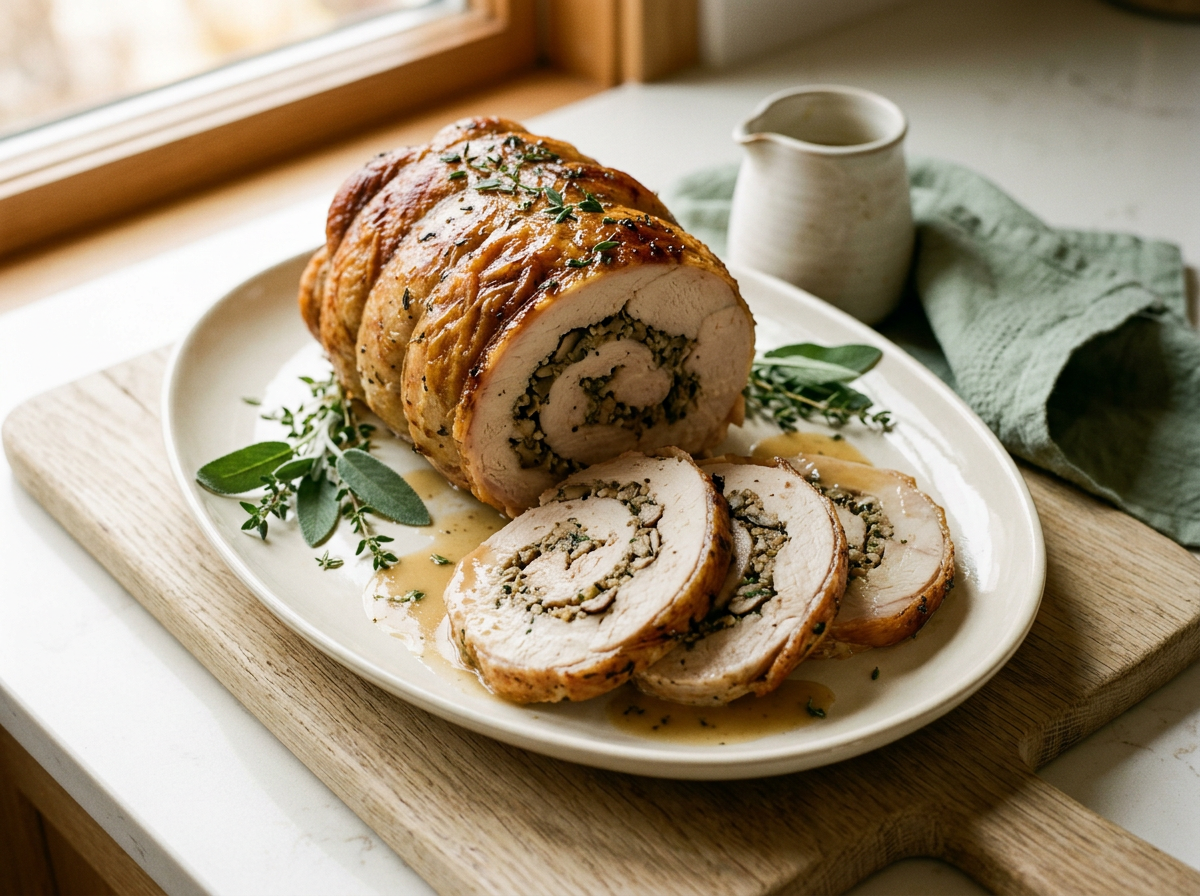
Golden roasted turkey, a savory mushroom stuffing, and a spoonful of warm pan sauce make a holiday centerpiece that feels special before you even take a bite. Slice into this turkey roulade and each piece reveals a spiral of finely chopped mushrooms, shallots, and fresh herbs tucked inside tender turkey breast.
Turkey roulade is a lovely choice for a smaller Thanksgiving dinner, when a whole bird may be more than you need, but it works just as well for a Christmas gathering or a cozy dinner with friends. The bread-free stuffing and flourless gravy also make this a recipe a great gluten-free option for the holidays. The presentation looks elaborate, yet the process is straightforward: flatten the breast, spread on the stuffing, roll it up, and secure it with kitchen twine. Once it’s roasted, carving is as simple as cutting thick, even slices.
Why Make a Turkey Roulade?
A roulade gives familiar roast turkey a different presentation while keeping the flavors firmly rooted in the holiday season. Sage and thyme complement the turkey, while browned mushrooms bring an earthy richness that carries through every slice. The stuffing contains no bread, allowing the mushrooms and herbs to take center stage.
Using a boneless breast also makes serving easier. There are no bones to work around at the table, and the entire roast can be portioned on a cutting board before it reaches the platter. For guests who favor white meat, it’s an especially appealing option. The smaller cut generally cooks faster than a whole turkey, although the thickness of the finished roll determines its roasting time.
Choosing the Turkey and Mushrooms
For this recipe, buy one boneless, skin-on turkey breast half weighing about 2½ to 3 pounds. A whole turkey breast contains two halves; this recipe uses just one. Ask the butcher to remove the bone, leave the skin attached, and butterfly the meat for rolling. That small bit of preparation makes assembly much easier at home.
Look for an unseasoned breast if possible. Turkey labeled enhanced, injected, kosher, or pre-brined may already contain substantial salt, so reduce the added salt accordingly. Skin-on turkey gives the roulade a golden exterior, but a skinless breast will also work; brush it generously with the butter and expect a lighter finish.
A mixture of mushrooms creates a more interesting stuffing than a single variety. Shiitake contribute deep savory flavor, oyster mushrooms add tenderness, and cremini provide an accessible, flavorful base. A packaged cultivated “wild mushroom blend” is perfectly suitable here. If you’d like even more depth, a small amount of dried porcini can be rehydrated and added to the mixture.
The Secret to a Flavorful Mushroom Stuffing
The most important step happens in the skillet. Mushrooms release plenty of water as they cook, and that liquid needs time to evaporate before the stuffing goes into the turkey. Use a wide pan, work in batches, and let the mushrooms brown rather than continually stirring them. The finished mixture should be moist and tender, with no liquid pooling at the bottom of the skillet.
Finely chopping the mushrooms helps the stuffing spread evenly and makes the finished roulade easier to slice. Shallots and garlic add sweetness and aroma, while parsley brightens the richer sage and thyme. Let the stuffing cool before assembly so it is easy to handle, then fill and roast the turkey in the same cooking session.
How to Butterfly the Turkey Breast
Butterflying opens the thick breast into a wider, thinner piece that can be rolled around the stuffing. Start with fully thawed, cold turkey; it is easier to slice neatly than meat that has warmed and softened. Pat it dry and place it skin-side down on a stable cutting board, with the thickest side facing your knife hand. Put a damp towel beneath the board if it slides.

Hold a sharp chef’s knife parallel to the cutting board and begin cutting horizontally into the thickest side, roughly halfway between the board and the top of the meat. Use short, controlled strokes, working slowly toward the opposite edge. Keep your other hand flat on top of the breast, with your fingers above and away from the blade. Stop about ½ inch before reaching the far edge, leaving an attached strip of meat that acts as a hinge. Do not cut through that hinge or the skin underneath.
Open the cut portion like a book and lay it flat, with the skin still underneath. If one section remains particularly thick, make a shallow horizontal cut into that section and unfold it outward, taking care not to cut all the way through. Aim for a broad, roughly rectangular piece rather than a perfect shape.
Cover the opened breast with plastic wrap and use the smooth side of a meat mallet or a rolling pin to gently flatten the thick areas. Work outward from the thicker center, using light strokes, until the meat is approximately ½ inch thick throughout. Avoid pounding the already-thin edges. Remove and discard the plastic wrap. If the butcher has already butterflied the breast, simply check its thickness and gently even it out as needed.
How to Fill and Roll the Turkey Roulade
Keep the flattened turkey skin-side down, with a long edge nearest you. Gently straighten any folded skin underneath so it can wrap around the outside as you roll. Season the exposed meat, then spread the cooled mushroom stuffing over it in a thin, even layer. Leave about 1 inch of bare turkey around the edges, especially along the far edge where the roll will close. Use the amount of stuffing that fits comfortably; piling it on thickly makes the roulade harder to secure.

Starting with the long edge nearest you, lift the turkey with both hands and fold it over the first portion of stuffing. Tuck that edge inward gently to begin a snug roll, then continue rolling away from you. Work along the entire length so both ends move forward together. Use your fingertips to guide the stuffing inward if it starts to escape, but avoid squeezing the meat or pressing the stuffing out.

Finish with the bare far edge tucked underneath the cylinder. The skin should cover as much of the outside as possible, with the seam resting against the board. A little stuffing showing at either end is normal. If the edges cannot meet, carefully unroll the breast, remove some stuffing, and try again. The finished roll should feel compact and hold its shape without needing to be forced closed.
How to Tie the Turkey Roulade
Separate pieces of kitchen twine are an easy way to secure the roast; you do not need to master a continuous butcher’s knot. Before handling the filled turkey, cut five or six pieces of food-safe cotton kitchen twine, each about 18 inches long. Have an extra piece ready in case the roll needs additional support. Keep the roulade seam-side down while you work.

Begin at the center. Carefully slide one piece of twine beneath the roll, bring both ends up over the top, and cross them. Pass one end under the other twice to form a surgeon’s knot, then pull gently until the twine rests snugly against the turkey. The extra turn helps prevent the first knot from slipping while you make a second, ordinary knot on top. The twine should make only a slight indentation; deep grooves or bulging meat mean it is too tight.
Add ties on either side of the center, spacing them approximately 1½ inches apart and keeping the outermost ties about 1 inch from the ends. Securing the center first helps keep the stuffing evenly distributed as you work outward. Trim the loose ends of each knot to about ½ inch so they will not trail in the roasting pan.
If an end flap is loose, tuck it inward and add a separate lengthwise piece of twine around the roast, tying it on top. Otherwise, the crosswise ties are sufficient. Check that the seam remains underneath, then brush the outside with butter, season, and transfer the roulade to the roasting pan. After roasting and resting, snip every tie with kitchen scissors and pull all twine away before slicing.
Recipe: Turkey Roulade with Mushroom and Herb Stuffing
Makes 6 servings
Ingredients
For the mushroom stuffing:
- 1 pound mixed mushrooms, such as cremini, shiitake, and oyster
- ¼ ounce dried porcini mushrooms, optional
- ½ cup hot water, if using dried porcini
- 2 tablespoons olive oil, divided
- 2 tablespoons unsalted butter
- 2 medium shallots, finely chopped
- 3 garlic cloves, minced
- 1 tablespoon finely chopped fresh sage
- 2 teaspoons fresh thyme leaves
- 2 tablespoons finely chopped fresh parsley
- ½ teaspoon kosher salt, plus more to taste
- ¼ teaspoon freshly ground black pepper
For the turkey:
- 1 boneless, skin-on turkey breast half, 2½–3 pounds, fully thawed
- 1½ teaspoons Diamond Crystal kosher salt or ¾ teaspoon Morton kosher salt, reduced if the turkey is pre-brined
- ½ teaspoon freshly ground black pepper
- 2 tablespoons unsalted butter, softened
- ½ cup low-sodium turkey or chicken broth, plus more as needed for the roasting pan
For the pan sauce:
- Reserved roasting juices
- ½ cup dry white wine, or additional low-sodium broth
- ¾ cup low-sodium turkey or chicken broth
- 1 teaspoon Dijon mustard, optional
- 1 teaspoon cornstarch mixed with 1 tablespoon cold water, optional
- 1 tablespoon cold unsalted butter
- Salt and freshly ground black pepper, to taste
Equipment: Kitchen twine, meat mallet or rolling pin, small roasting pan, and an instant-read thermometer.
Instructions
- If using dried porcini, place them in a small bowl with the hot water and soak for 15–20 minutes. Lift out the mushrooms, rinse away any grit, squeeze gently, and finely chop. Discard the soaking liquid. Trim the fresh mushrooms, removing tough shiitake stems and firm oyster mushroom bases, then finely chop.
- Heat 1 tablespoon olive oil in a large skillet over medium-high heat. Add half the fresh mushrooms and cook for 6–8 minutes, stirring occasionally, until their liquid evaporates and they begin to brown. Transfer to a bowl. Repeat with the remaining tablespoon of oil and fresh mushrooms.
- Reduce the heat to medium and melt the 2 tablespoons butter in the skillet. Add the shallots and cook for 3–4 minutes until softened. Stir in the garlic, sage, and thyme and cook for 30 seconds. Return the browned mushrooms to the skillet and add the porcini, if using. Season with the stuffing salt and pepper. Cook for another 2–3 minutes, until no liquid remains in the pan. Stir in the parsley and taste for seasoning.
- Spread the stuffing in a shallow dish and let it cool while you prepare the turkey, about 15–20 minutes. Preheat the oven to 375°F.
- Butterfly the turkey and gently flatten it to approximately ½ inch thick, following the detailed directions above. Leave the skin underneath.
- Season the exposed meat with half the turkey salt and pepper. Spread with a thin, even layer of cooled stuffing, leaving a 1-inch border.
- Roll snugly from a long edge and place seam-side down. Secure with kitchen twine at approximately 1½-inch intervals, using the rolling and tying directions above.
- Rub the exterior with the softened butter and season with the remaining turkey salt and pepper. Place seam-side down in a small roasting pan. Pour the ½ cup broth around, rather than over, the turkey.
- Roast for approximately 70–100 minutes, beginning temperature checks at 60 minutes. Add a splash of broth if the pan becomes dry, and loosely tent with foil if the skin browns too quickly. Check several places with an instant-read thermometer: both the thickest turkey meat and the center of the mushroom stuffing must reach 165°F. Use temperature, rather than the clock, to determine doneness.
- Transfer the roulade to a cutting board and loosely tent with foil. Rest for 15–20 minutes while making the sauce.
- Pour the roasting juices into a heatproof measuring cup and skim off excess fat. If needed, loosen browned bits in the roasting pan with a little of the measured broth, scraping with a wooden spoon, and add this liquid to the juices. Use only brown drippings; leave any blackened or burnt bits behind.
- In a small saucepan, bring the wine to a simmer over medium heat and cook until reduced by about half, 3–4 minutes. Add the reserved juices, remaining measured broth, and Dijon, if using. Simmer for 4–6 minutes. For a slightly thicker sauce, stir the cornstarch slurry again, add it gradually, and simmer for 1–2 minutes. Remove from the heat and whisk in the cold butter. Taste before adding salt and pepper.
- Remove all twine from the turkey. Use a sharp carving knife to cut into ¾-inch slices. Arrange on a warm platter and serve with the pan sauce.
Recipe Notes
- For a wine-free sauce, substitute broth for the wine and add a small squeeze of lemon juice at the end if desired.
- If using dried herbs, substitute 1 teaspoon dried sage and ¾ teaspoon dried thyme. Keep the parsley fresh if possible.
- For a gluten-free version, verify that the broth, Dijon, and other packaged ingredients are gluten-free.
- Roast any excess stuffing that has touched raw turkey separately in a small, covered baking dish until it reaches 165°F.
Tips for Juicy Turkey and Clean Slices
The diameter of the finished roll matters more than its length when judging cooking time. A thick, compact turkey roulade takes longer to heat through than a narrower one of the same weight. Begin checking early and measure both the thickest turkey meat and the center of the stuffing, making sure each reaches 165°F. If the exterior is browning faster than the center is cooking, loosely tent it with foil.
Rest the roast for 15–20 minutes before carving, leaving the twine in place to support its shape during the rest. Remove every piece of twine, then use a sharp carving knife to cut ¾-inch slices with smooth strokes rather than pressing straight down. A broad spatula makes it easier to transfer the slices to a platter without disturbing the mushroom spiral.
Make-Ahead Preparation
You can take care of much of the preparation before guests arrive. Cook the mushroom stuffing up to two days ahead, refrigerate it promptly in a shallow covered container, and keep it chilled until assembly. The turkey can also be butterflied a day ahead and stored separately, covered, in the refrigerator, provided it remains within its original safe storage period.
For this recipe, leave the stuffing and raw turkey separate until you’re ready to roast. Have the oven preheated and the twine cut before you begin, then fill, roll, tie, and cook in one session. This still removes most of the chopping and skillet work from the day of the meal.
What to Serve with Turkey Roulade
Mashed potatoes are a natural partner for the mushroom stuffing and pan sauce, especially if you want a plate that feels familiar at Thanksgiving. Roasted green beans, carrots, or Brussels sprouts add color and texture, while cranberry sauce brings a welcome sweet-tart contrast to the savory turkey.
For a smaller dinner, potatoes and one vegetable are plenty alongside the roulade. If you’re serving it as part of a larger holiday spread, it also pairs well with a simple fall salad of greens, apples, and a sharp vinaigrette. Choose sides that leave room for the mushroom-and-herb stuffing to stand out.
Storing and Reheating Leftovers
Refrigerate leftover turkey in shallow, airtight containers within two hours of cooking and use within three to four days. Store the pan sauce separately and use within one to two days. For longer storage, freeze turkey slices in meal-size portions with a little broth for up to two to three months for best quality.
To reheat, arrange the slices in a baking dish, add a little broth, and cover tightly. Warm in a 325°F oven until the turkey and stuffing reach 165°F; the time will depend on the thickness and number of slices. Reheat the sauce separately, bringing it to a boil and adding a splash of broth if it has thickened. Leftover slices also make an excellent sandwich with cranberry sauce and a handful of greens.
Turkey roulade brings the familiar flavors of a holiday roast to a platter that’s simple to carve and share. The golden exterior, earthy stuffing, and fresh herbs give each slice plenty of character, whether you’re serving six at Thanksgiving or making a special Sunday dinner. Spoon a little warm sauce over the turkey, pass the rest at the table, and let everyone settle in.



Leave a Reply