
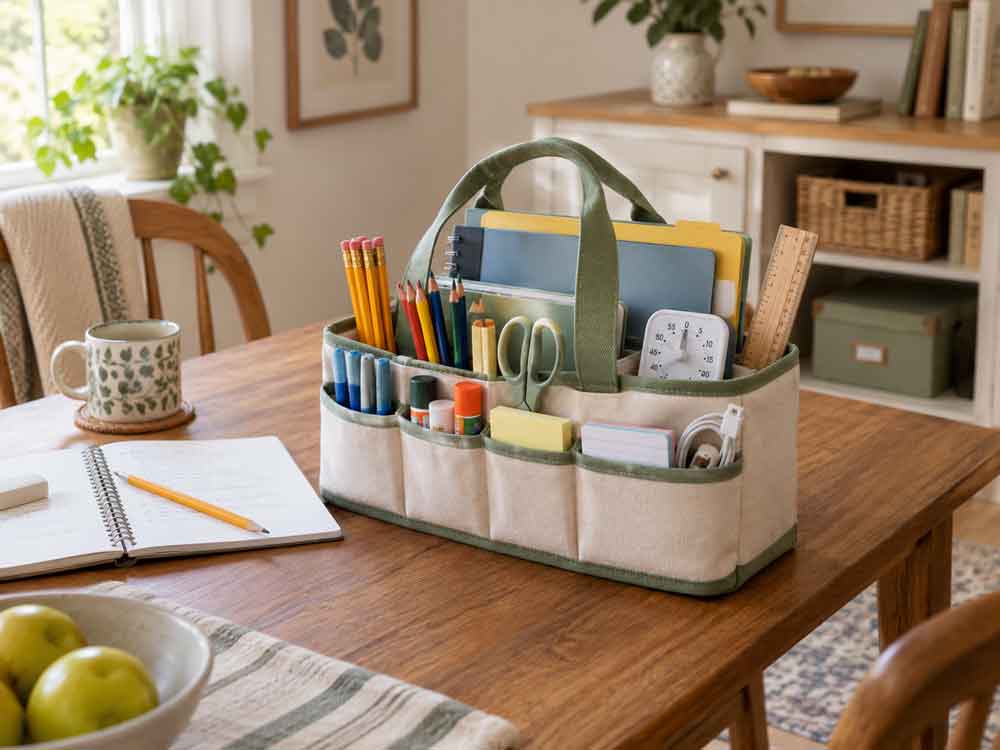
A dedicated homework room sounds wonderful, but it is not a realistic option in every home. Many families rely on a kitchen island, dining table, coffee table, or shared desk for schoolwork. Those spaces can work perfectly well, but only if pencils, papers, chargers, and other supplies are easy to find and equally easy to clear away.
A portable homework station creates a consistent place for essentials without permanently giving up a room or tabletop. When homework begins, the station comes out and transforms an everyday surface into a functional workspace. When the work is finished, everything goes back into the container, and the room returns to its usual purpose.
The best version is not necessarily the largest or most elaborate. A compact, thoughtfully stocked system is easier for children to use, carry, and maintain. With the right container and a few simple routines, you can create a homework station that makes school nights feel calmer and more organized.
Why a Portable Homework Station Works
Much of the frustration surrounding homework begins before anyone completes a single problem. A child cannot find a sharpened pencil. The glue stick is dried out. A worksheet is buried under mail on the counter. Someone needs a charger that has disappeared into another room. Each small interruption makes it harder to settle down and concentrate.
A portable homework station keeps the most frequently used supplies in one predictable place. Children know where to look, and parents do not have to gather materials from around the house every afternoon. This consistency can make the transition into homework time feel more automatic.
The station also provides structure without requiring a permanent desk. It can be carried to whichever area is available that day, whether that is the dining table before dinner or a quieter corner when the rest of the house is busy. Once homework is complete, the supplies can be packed away so the surface is ready for meals, projects, or family time.
Choose the Right Container
Begin by choosing a container that fits both your child’s needs and the space where the station will be stored. A handled caddy works well for younger children who primarily use pencils, crayons, scissors, and glue. Its open compartments make supplies easy to see, and it can usually be carried without help.

Older students may need a lidded bin, divided tote, or sturdy art-supply case with room for notebooks, index cards, a calculator, headphones, and charging cords. A small rolling cart is another option if the station needs to hold supplies for several children, although it works best when it can be rolled into a nearby closet or corner.
Before purchasing anything, decide where the station will go at the end of the day. Measure the cabinet, pantry shelf, closet floor, or console table where you plan to keep it. A container that fits its storage spot is much more likely to be put away consistently.
Try not to choose a container that is much larger than necessary. Extra room tends to attract old papers, dried-out markers, toys, and other items that make the station harder to use. The goal is to create a focused collection of essentials, not a mobile version of an overflowing junk drawer.
Stock the Everyday Essentials
The contents of the station should reflect the work your child regularly brings home. Elementary students may need coloring and craft supplies, while middle- and high-school students will rely more heavily on highlighters, calculators, headphones, and technology accessories.
A basic station might include:
- Sharpened pencils and erasers
- Blue or black pens
- Colored pencils, crayons, or washable markers
- Highlighters
- A pencil sharpener with a covered shavings compartment
- Scissors
- Glue sticks
- A ruler
- Sticky notes
- Index cards
- Lined and plain paper
- A calculator, if needed
- Headphones
- Frequently used charging cables
- A small timer
You do not need to include every school supply your child owns. Store poster board, paint, specialty craft materials, and bulk packages elsewhere, then bring them out when a particular assignment calls for them. Keeping only everyday essentials in the portable station prevents it from becoming too heavy or cluttered.
It is also helpful to include a few practical items that address predictable interruptions. A small packet of tissues, a bookmark, extra pencil lead, or a compact pair of reading glasses can keep a child from wandering away from the work area and becoming distracted.
Divide Supplies into Easy-to-Reach Zones
Even a small container can become disorganized if every item is dropped into one large compartment. Use pencil cups, zipper pouches, small trays, or removable boxes to divide supplies into clear categories.
Writing tools can go in one section, coloring supplies in another, and scissors and glue in a third. Technology accessories should have their own pouch, so cords do not become tangled around pencils and rulers. Small items, such as erasers, pencil lead, and paper clips, are easier to manage in a lidded container.
Organize the station according to how your child naturally works. If colored pencils are used nearly every night, place them where they can be removed quickly. Supplies that are only needed occasionally can sit at the bottom or back.
Children are more likely to maintain a system when they can understand it at a glance. Labels can help, especially for younger students, but the categories should remain broad. A few clearly defined sections are easier to use than a complicated arrangement in which every pencil and glue stick has a highly specific place.
Add a Simple Paper Management System
Loose papers are often more difficult to manage than the supplies themselves. A small folder system can prevent assignments, permission slips, and completed work from disappearing between school and home.

Create one folder for work that still needs attention and another for papers that are ready to return to school. If your child frequently brings home forms that require a signature, add a third folder for parent review. Clearly label each one using short, direct phrases such as “To Do,” “Take to School,” and “Parent Review.”
An expandable file can serve the same purpose for a student who manages papers from several classes. Label one section for each subject but reserve the file for current assignments and reference sheets. Completed work that no longer needs to travel back to school should be filed or recycled elsewhere.
Encourage your child to empty the backpack directly into this system at the start of homework time. Once the work is finished, completed assignments should immediately return to the correct folder and then to the backpack. This closes the loop and reduces the chance that finished homework will be left on the kitchen table the next morning.
Make It Work for More Than One Child
A shared homework station can work well for siblings, provided each child has a clearly defined place for personal materials. Keep general supplies, such as scissors, rulers, paper, and a pencil sharpener, in the central container. Give each child a separate pencil case or zippered pouch for preferred pens, specialty tools, and small items.
Color coding is an easy way to distinguish personal supplies. One child might have a blue pouch and matching folder labels, while another uses green. The colors make items easy to identify without requiring a long list of rules.
Separate folders are especially important when children attend different schools or have several teachers. Each child should have an individual place for active assignments and papers that need to return to school.
If siblings frequently do homework at the same time in different rooms, several small kits may be more practical than one large, shared station. Each kit can contain basic writing tools, while less commonly used materials remain in a central household supply bin. The best system is the one that minimizes competition for supplies and does not require constant adult supervision.
Choose a Consistent Setup Spot
A portable homework station can move when necessary but having one or two preferred locations creates helpful predictability. Choose a surface with comfortable seating, good lighting, and enough room to spread out the current assignment without covering the table in unnecessary supplies.

For many families, the dining table is the most practical option. It offers a generous work surface and allows a parent to remain nearby while preparing dinner or handling other tasks. A kitchen counter may work for brief assignments, while a small folding table can create a temporary study area in a bedroom or quiet hallway.
Pay attention to the child rather than following a universal rule about the “perfect” location. Some children concentrate best in a quiet room. Others work more comfortably with a parent nearby. The space should offer the level of supervision and background activity that helps your child remain focused.
Keep a washable desk mat or large placemat with the station if homework involves markers, glue, or frequent erasing. It will define the workspace and protect the table. When the mat is rolled up and put away, it also provides a clear visual signal that homework time is over.
Create a Quick Setup Routine
A predictable setup routine helps children begin working without waiting for repeated instructions. The routine should be simple enough to complete independently and brief enough that it does not become another form of procrastination.
Start by clearing unrelated dishes, mail, toys, and devices from the work surface. Bring out the homework station and remove only the supplies needed for the first assignment. Place folders, a water bottle, and any required device within easy reach.
If your child uses a timer, set it before work begins. The timer might mark a focused work period, a planned break, or the amount of time available before dinner. It should support concentration rather than create pressure.
Encourage your child to begin with the assignment that requires the most attention, particularly if energy tends to fade later in the evening. Smaller or more enjoyable tasks can follow. Once this rhythm becomes familiar, setting up the station will act as a cue that it is time to shift into schoolwork.
Make Packing Away Part of the Routine
A portable system only works when putting it away is as easy as setting it up. At the end of homework time, have your child return every supply to its section, place completed work in the appropriate folder, and put papers back into the backpack.

Take a moment to sharpen pencils, close marker caps, and replace anything that has run out. Chargers can be returned to their pouch or connected to devices that need to charge overnight. The tabletop should then be cleared and wiped so it is ready for its next use.
This reset does not need to take more than a few minutes. In fact, keeping it short makes it easier to maintain. The goal is not to achieve a perfectly arranged container every night. It is to ensure that the station is complete, usable, and ready when homework begins again.
Younger children may need help with the routine at first. A small, laminated checklist attached to the inside of the lid can provide a visual reminder until the steps become automatic.
Personalize the Station Without Adding Clutter
A homework station should feel welcoming, particularly if you want your child to take ownership of it. Let your child choose a container color, decorate a label, or select a pencil pouch. These small decisions can make the station feel personal without interfering with its function.
Useful reference materials can also be added. A younger child might benefit from a laminated alphabet strip, multiplication chart, or list of frequently used words. An older student may need a weekly schedule, formula card, or assignment checklist.
Limit these additions to materials that are currently helpful. Too many reference sheets create visual noise and make important information harder to find. Rotate them as classroom topics and homework needs change.
A small encouraging note can be a thoughtful addition, but keep decorations restrained. Toys, novelty erasers, and excessive accessories can quickly become distractions. The station should feel pleasant and personal while still signaling that it is a place for focused work.
Keep the Station Useful Throughout the School Year
Even a well-organized homework station needs occasional attention. Once a week, check for broken pencils, dried-out markers, empty glue sticks, tangled cords, and papers that no longer belong in the container. Restock from a separate supply cabinet rather than keeping full packages in the station.
At the end of each grading period, empty the container completely and wipe it clean. Ask whether each item is still being used. Remove outdated study guides, return misplaced household items, and adjust the contents for upcoming projects or new classes.
The station may need to evolve as the school year progresses. A child who begins the year using crayons and handwriting paper may later need flash cards or a ruler more frequently. An older student may start bringing home a school-issued device and require a dedicated charging setup.
During school breaks, the container can be adapted for summer learning, journaling, puzzles, or crafts. Maintaining the basic structure makes it useful beyond nightly homework while still allowing it to change with your family’s needs.
Common Mistakes to Avoid
One of the easiest mistakes is trying to stock the station for every possible assignment. Too many supplies make the container heavy, cluttered, and difficult to maintain. Keep the portable station focused on everyday tasks and store specialty materials separately.
The container should also be easy for the child to access. If it is stored on a high shelf or is too heavy to carry, an adult will have to set it up every evening. Whenever possible, place it where your child can retrieve and return it independently.
Avoid letting the station become a permanent home for old schoolwork. Current papers should move through the system, while work worth saving should have a separate long-term storage location.
Finally, resist the urge to create an overly detailed organization system. If putting away a pencil requires too much thought, the system will not last. Broad categories, clear labels, and a short daily reset are usually enough to keep everything in order.
A productive homework area does not require a dedicated office, custom built-ins, or a desk that remains set up around the clock. A portable station can give children the supplies and structure they need while allowing shared rooms to serve the entire family.
Start with a manageable container, fill it with the materials your child actually uses, and give each item an obvious place. Pair the station with simple setup and pack-away routines that children can gradually learn to complete on their own.
When everything needed for homework is ready to travel together, nearly any table can become a useful study space. A few minutes later, it can become the family dinner table again.


Leave a Reply