
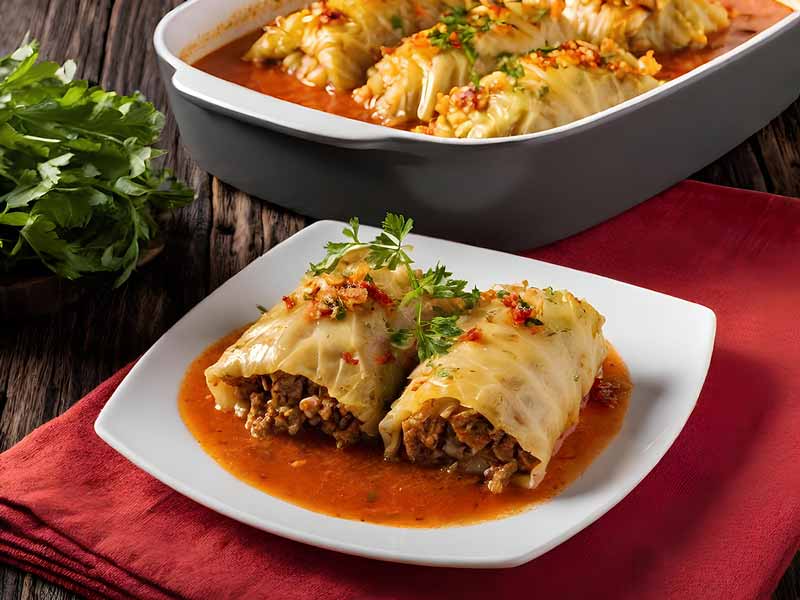
Tender cabbage leaves wrapped around a savory filling, gently simmered in tomato sauce, create a dish that feels both humble and deeply satisfying. It’s the kind of meal that fills the kitchen with warmth and the table with anticipation.
Stuffed cabbage rolls have roots across Eastern European, Mediterranean, and Middle Eastern cuisines, and nearly every culture has its own variation. Some lean sweet and tangy, others rich and herb-forward. Some are tightly rolled into neat bundles, while others are looser, flatter, and rustic. That flexibility is part of their enduring appeal.
In this version, we’ll focus on a classic, balanced filling made with ground beef, rice, and finely diced carrots, onion, celery, and bell pepper, all topped with a light, thin tomato sauce. It’s hearty without being heavy, flavorful without being complicated, and forgiving in both technique and presentation. These are rustic stuffed cabbage rolls—no need for perfect shapes or uniform sizes. Round, rectangular, even slightly triangular rolls are all welcome here.
Why Stuffed Cabbage Rolls Are So Flexible
One of the greatest strengths of stuffed cabbage rolls is their adaptability. Once you understand the structure—cabbage leaves wrapped around a savory filling and simmered in sauce—you can adjust the ingredients to suit your taste, pantry, or dietary preferences.
Protein Options
Ground beef is traditional and deeply flavorful, but it’s far from the only option. Ground pork adds richness, while ground turkey or chicken create a lighter version. Ground lamb brings depth and pairs beautifully with herbs like mint and parsley. For a vegetarian version, lentils and mushrooms can replace meat while still providing satisfying texture and protein.
Grain Options
Rice is the most common grain used in stuffed cabbage rolls, and it’s what we’ll use in the featured recipe. But brown rice, quinoa, bulgur, or even barley work well. The grain acts as a binder, absorbs juices as the rolls cook, and helps stretch the filling into a complete meal.
Vegetable Variations
The featured filling includes finely diced carrots, onion, celery, and bell pepper—classic aromatic vegetables that add sweetness and balance. But mushrooms, zucchini, spinach, or fresh herbs can easily be incorporated. The key is chopping everything finely so the filling remains cohesive and easy to roll.
Sauce Variations
A thin tomato sauce is traditional and ideal for gentle simmering. However, you can lean into a sweet-and-sour tomato sauce, add cream for richness, or even use a light broth with herbs and lemon for a different direction.
While the possibilities are broad, the recipe below provides a dependable and well-balanced starting point.
Ingredient Breakdown
Understanding how each component works ensures the best possible results.
Cabbage
Green cabbage is ideal for stuffed cabbage rolls. Its large, flexible leaves soften beautifully when blanched. Savoy cabbage can also work and offers slightly more delicate leaves.
The size of the cabbage leaves will naturally influence the shape of your rolls. Larger outer leaves may produce flatter, rectangular rolls, while smaller inner leaves can create rounder, compact bundles. Embrace this variation—uniformity isn’t required.
Ground Beef
An 80/20 or 85/15 blend provides enough fat for flavor while keeping the filling moist. As the rolls cook, the beef releases juices that blend with the tomato sauce, enriching it naturally.
Rice
Uncooked white rice works well because it absorbs moisture as the rolls bake. Alternatively, partially cooked rice can shorten the baking time slightly. The rice binds the filling and ensures a tender texture.
Finely Diced Vegetables
Carrots add subtle sweetness. Onion builds savory depth. Celery contributes aromatic balance. Bell pepper introduces freshness and lightness. Finely dicing is important so the filling holds together smoothly.
Thin Tomato Sauce
A lightly seasoned, thinner tomato sauce allows the cabbage rolls to gently simmer rather than bake dry. It should be pourable and lightly seasoned with salt and pepper, allowing the flavors of the filling to shine through.
Recipe: Stuffed Cabbage Rolls with Beef and Rice
Makes 10-12 rolls
Ingredients
For the cabbage:
- 1 large green cabbage
- Water for blanching
For the filling:
- 1 pound ground beef
- ¾ cup uncooked white rice
- 1 small carrot, finely diced
- ½ small onion, finely diced
- 1 stalk celery, finely diced
- ½ bell pepper, finely diced
- 2 cloves garlic, minced
- 1 teaspoon salt
- ½ teaspoon black pepper
- 1 tablespoon chopped fresh parsley (optional)
For the sauce:
- 2 cups crushed tomatoes
- ½ cup water or beef broth
- ½ teaspoon salt
- ¼ teaspoon black pepper
Instructions
- Begin by preparing the cabbage. Bring a large pot of salted water to a boil. Carefully core the cabbage and place it into the boiling water. As the outer leaves soften and loosen, gently remove them with tongs. Continue until you have 10 to 12 large, pliable leaves. Lay them flat and allow them to cool. Trim any thick stems to make rolling easier.
- Preheat your oven to 350°F (175°C).
- In a large bowl, combine the ground beef, uncooked rice, finely diced carrot, onion, celery, bell pepper, garlic, salt, pepper, and parsley. Mix gently with your hands just until combined—avoid overmixing, which can make the filling dense.
- Spoon about ⅓ to ½ cup of filling onto the lower third of each cabbage leaf. Fold the sides inward, then roll upward to enclose the filling. The shape will depend on the size of the leaf—some may be round, others more rectangular or slightly triangular. The goal is simply to tuck the filling securely inside.
- In a baking dish, spread a thin layer of the tomato sauce mixture on the bottom. Arrange the rolls seam-side down in a snug single layer. Pour the remaining sauce evenly over the top.
- Cover tightly with foil and bake for about 1 hour to 1 hour 15 minutes, or until the cabbage is tender and the rice inside the rolls is fully cooked. Let rest for 10 minutes before serving.
Embracing the Rustic Nature of Stuffed Cabbage Rolls
Stuffed cabbage rolls are not meant to look perfectly uniform. Their rustic appearance is part of their charm. Larger outer cabbage leaves may produce wide, flatter rolls. Smaller inner leaves can create compact, round bundles. Occasionally, you may even form a triangular roll if the leaf dictates it.
As long as the filling is enclosed and the rolls are arranged snugly in the baking dish, they will cook beautifully. Don’t worry about perfection—this dish is about comfort, not precision.
Delicious Variations
Vegetarian Stuffed Cabbage Rolls
Replace the ground beef with a mixture of cooked lentils and sautéed finely chopped mushrooms. Combine with rice or quinoa, diced carrots and onion, garlic, and parsley. The mushrooms add umami while lentils provide hearty texture. Bake with the same thin tomato sauce or a light vegetable broth-tomato blend.
Greek Cabbage Rolls
For a Mediterranean-inspired variation, use cooked orzo, finely chopped fresh spinach, crumbled feta, diced onion, dill, parsley, and lemon zest. The feta melts slightly into the filling, creating creamy pockets of flavor. Top with a lightly seasoned tomato sauce with oregano or even a simple lemony broth.
Ground Turkey and Brown Rice
Substitute ground turkey for beef and use cooked brown rice. Add thyme and a touch of Worcestershire sauce for depth. This version is lighter but still deeply comforting.
Italian-Inspired Sausage Rolls
Use mild Italian sausage in place of ground beef. Add fresh basil and grated Parmesan to the filling. Top with a thin marinara-style sauce and finish with extra Parmesan before serving.
Sweet-and-Sour Variation
Keep the classic beef and rice filling but adjust the sauce by adding a spoonful of brown sugar and a splash of apple cider vinegar. The balance of sweet and tangy adds nostalgic depth.
Lamb and Herb Version
Ground lamb combined with rice or bulgur, garlic, mint, and parsley creates a rich and aromatic variation. A lightly spiced tomato-cumin sauce complements it beautifully.
Make-Ahead, Storage, and Freezing
Stuffed cabbage rolls are ideal for making ahead. Assemble them fully and refrigerate, covered, for up to 24 hours before baking. You may need to add 10–15 minutes to the baking time if starting from cold.
They also freeze well. Freeze assembled, unbaked rolls in a tightly wrapped dish, or freeze fully cooked leftovers in airtight containers for up to three months.
Reheat covered in the oven at 325°F until warmed through, adding a splash of broth if needed to prevent drying.
Serving Suggestions
Serve stuffed cabbage rolls family-style with extra sauce spooned over the top. They pair beautifully with mashed potatoes, buttered egg noodles, or crusty bread. A simple green salad adds freshness to balance the richness.
A dollop of sour cream or a sprinkle of fresh herbs makes a lovely finishing touch.
Stuffed cabbage rolls are a timeless example of how simple ingredients can create something deeply satisfying. With a foundation of cabbage, filling, and sauce, the recipe welcomes adaptation—different meats, grains, vegetables, and flavor profiles can all find a home inside those tender leaves.
Whether you stick to the classic beef and rice filling or experiment with Greek-inspired or vegetarian versions, embrace the rustic nature of the dish. Perfectly shaped rolls aren’t the goal. Comfort, flavor, and a generous pan of something warm from the oven—that’s what stuffed cabbage rolls are all about.



Leave a Reply