
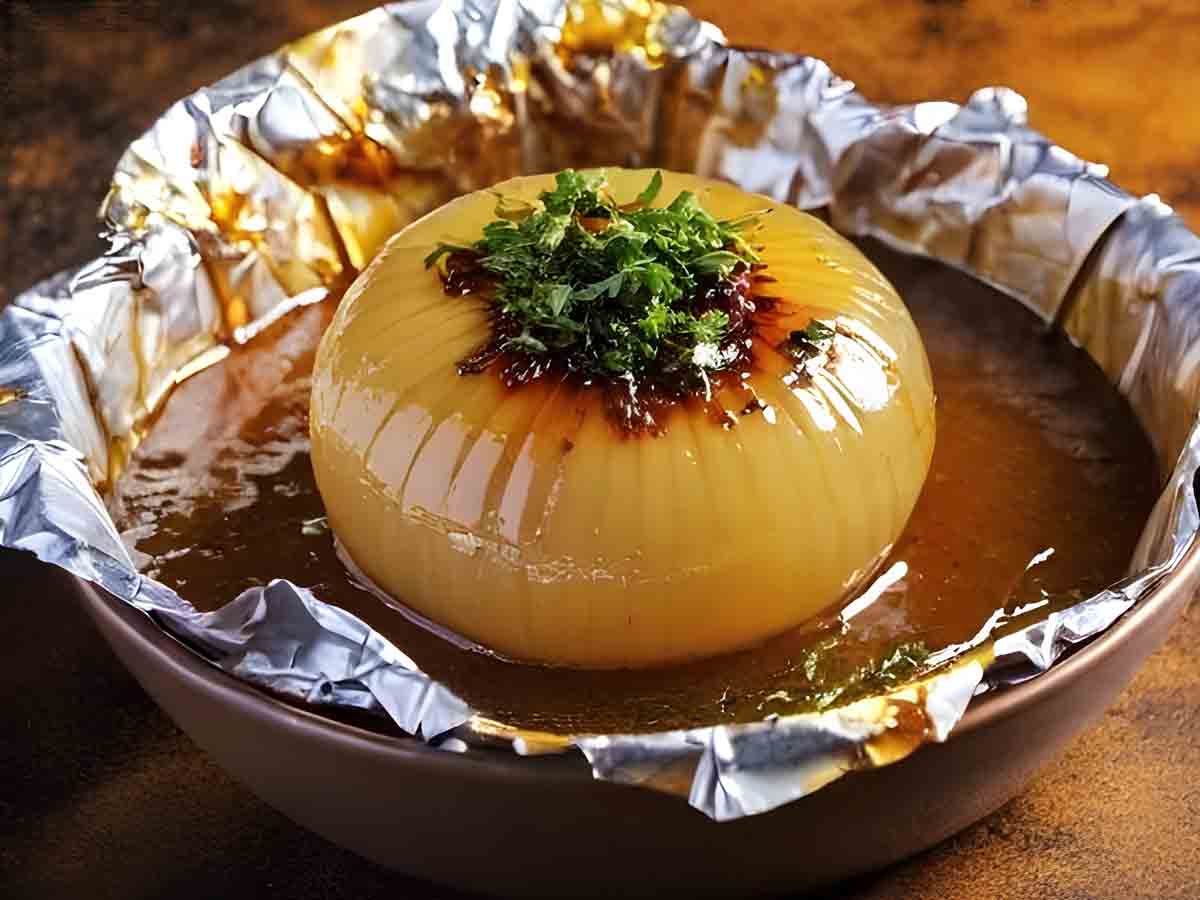
At first glance, the viral onion boil looks almost too simple to be worth the hype: a whole onion, butter, seasoning, wrapped up and baked until soft. No browning, no careful knife work, no complicated steps. And yet, once you cut into it, the appeal becomes obvious. What starts as a humble onion transforms into something deeply savory, sweet, and almost spoonable—bathed in its own buttery juices and rich with umami.
Part of the reason this recipe took off on social media is its dramatic before-and-after. A raw onion feels sharp and assertive; a fully cooked onion, given enough time and moisture, becomes mellow, rich, and comforting. The onion boil taps into that transformation while stripping the process down to its essentials. It’s not really a “boil” in the traditional sense, but rather a gentle bake that mimics the softening effect of simmering, while allowing the onion’s natural sugars to deepen and concentrate.
This is the kind of recipe that feels clever the first time you make it—and practical every time after.
What an Onion Boil Really Is
Despite the name, an onion boil is essentially a sealed, butter-basted onion bake. The onion is enclosed—usually in foil or a covered dish—with butter and seasoning, trapping steam as it cooks. This moist environment prevents browning and encourages the onion to soften evenly from the outside in.
As the onion heats, its cell walls break down, releasing moisture and natural sugars. The butter melts, mingles with those juices, and creates a sauce right inside the packet. Instead of crisp edges or char, you get a texture that’s tender, silky, and soft at the center. The flavor is intensely onion-forward but surprisingly gentle, making it appealing even to people who normally shy away from bold raw onion flavors.
Think of it less as a roasted vegetable and more like a slow-cooked side dish—one that just happens to require almost no effort.
Choosing Onions and Building Flavor
Not all onions behave the same way when cooked this gently. Sweet onions are the most popular choice for the classic version, thanks to their high sugar content and mild bite. Yellow onions also work beautifully, offering a slightly deeper, more savory profile once cooked through. Red onions can be used, but they tend to hold their structure more firmly and retain a sharper flavor.
Seasoning is where the onion boil becomes endlessly customizable. Salt is essential to draw out moisture and amplify sweetness, while butter provides richness and carries flavor. From there, you can keep things simple or layer in complexity: garlic cloves tucked into the onion, dried herbs, bouillon powder, chili crisp, soy-based seasonings, or even a splash of cream at the end. Because the onion cooks in a closed environment, flavors intensify quickly, so restraint goes a long way.
Recipe: Classic Viral Onion Boil
This is the version that made the rounds online for good reason. It’s dramatic, comforting, and surprisingly satisfying for something built around a single vegetable.
How it works
A whole peeled onion is seasoned, topped with butter, and tightly wrapped so steam can circulate. Over the course of baking, the onion softens completely, collapsing slightly and collecting a pool of buttery onion broth beneath it. When done, the onion should be easily pierced with a knife and practically fall apart when cut. Serve hot as a side dish, or split and spoon over steak, chicken, or roasted vegetables.
Ingredients
- 1 large sweet or yellow onion
- 2 tablespoons unsalted butter
- Salt and black pepper, to taste
- 1 tablespoon seasoning(s) of choice
Instructions
- Preheat the oven to 375°F.
- Peel the onion and trim the root end so it sits flat, keeping the onion intact.
- Cut the stem end flat and scoop a small portion of the core out.
- Season the entire onion generously with salt and pepper. Place the onion on a large piece of foil.
- Fill the core with the butter and top with optional seasonings.
- Wrap the foil tightly around the onion to seal in moisture.
- Bake for 45–60 minutes, until completely tender.
- Carefully unwrap and spoon the buttery juices over the top.
Seasoning Options
There are endless options for seasoning, ranging from a simple sprinkling of paprika and garlic powder to more complex prepared seasoning mixes such as Old Bay or Cajun seasoning. Keep in mind that if your seasoning mix contains salt, you may need to reduce the amount of salt in the recipe or skip it all together.
A Faster, Shareable Variation: Pearl Onion Boil

If the whole-onion version is cozy and dramatic, the pearl onion variation is practical and crowd-friendly. Using peeled pearl onions speeds up cooking and creates more surface area for seasoning and butter to cling to, resulting in a dish that feels somewhere between a vegetable side and a built-in sauce.
Pearl onions soften more evenly and quickly, making this version ideal for weeknight dinners or holiday tables where oven space and time are limited. The flavor is similar to the classic onion boil but slightly less sweet and more savory, with each onion absorbing the seasoned butter rather than releasing a single pool of juices.
Ingredients
- 14 oz peeled pearl onions (fresh or frozen)
- 3 tablespoons unsalted butter
- Salt and black pepper
- 1 tablespoon seasoning(s) of choice (see Seasoning Options, above)
Instructions
- Preheat the oven to 375°F.
- Place pearl onions in a small baking dish.
- Season with salt, pepper, and seasoning(s), then dot with butter.
- Cover tightly with foil.
- Bake for 30–40 minutes, stirring once, until tender and glossy.
- Uncover for the last 5 minutes if you want slight caramelization.
- Serve as a side dish, spooned over proteins, or piled onto toasted bread.
How to Serve the Onion Boil
The onion boil shines brightest when paired with simple foods that benefit from its richness. It’s excellent alongside steak, roasted chicken, pork chops, or even spooned over mashed potatoes or rice. The buttery onion juices can double as a sauce—don’t let them go to waste.
For a more elevated presentation, finish with fresh herbs or a light drizzle of olive oil. For comfort-food energy, serve it straight from the foil or baking dish with crusty bread to soak up every drop.
Why This Recipe Has Staying Power
Not every viral recipe earns a permanent place in the rotation—but this one does. The onion boil works because it respects the ingredient, leans into a proven cooking method, and delivers on comfort without complication. It’s adaptable, budget-friendly, and deeply satisfying, whether you make it once out of curiosity or return to it again and again as a dependable side dish.
Sometimes, the simplest ideas stick around for a reason.



Leave a Reply