
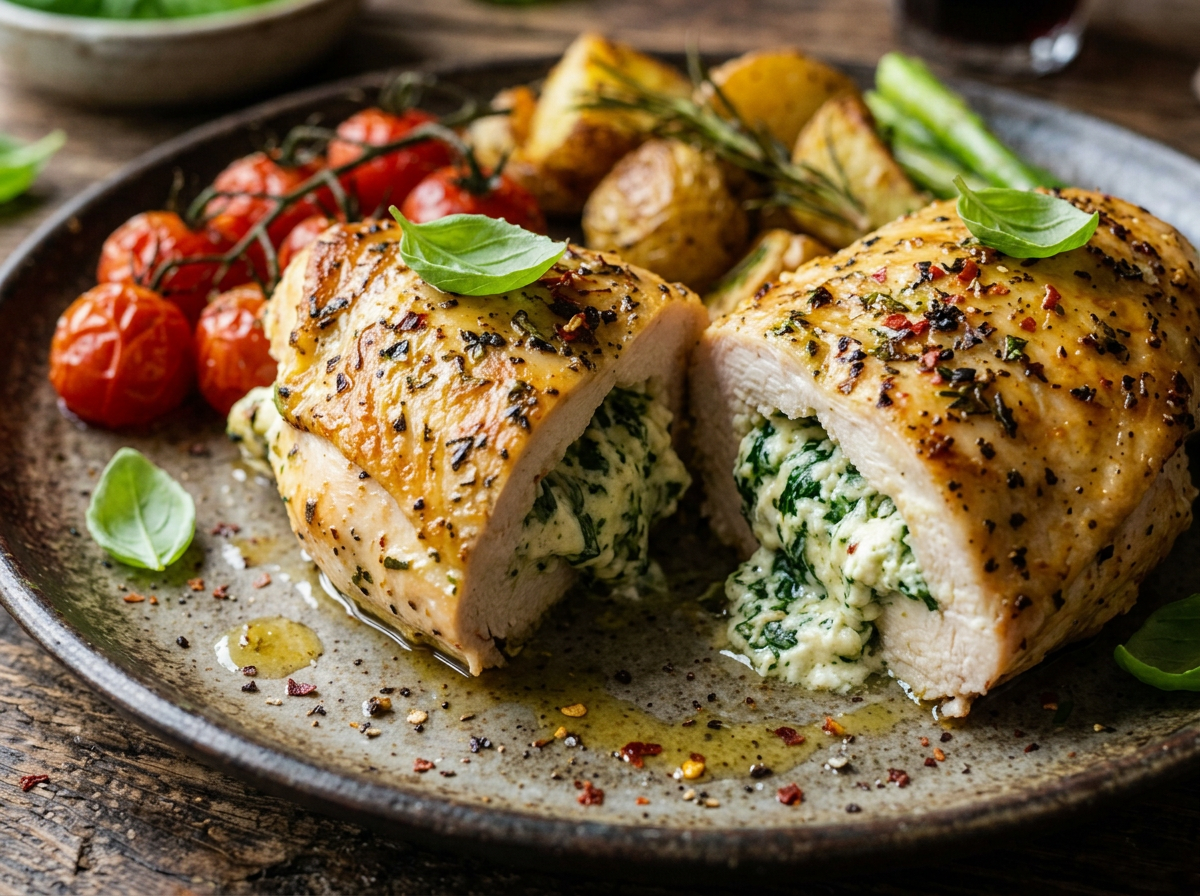
Basil and ricotta stuffed chicken looks and tastes far more elaborate than it is. From the outside, the chicken breasts are beautifully golden and seasoned with herbs. Slice into them, however, and you’ll find a creamy filling made with whole-milk ricotta, Parmesan, fresh basil, garlic, and a touch of lemon zest.
The combination is rich without feeling heavy. The mild ricotta lets the fresh basil shine, Parmesan contributes a savory depth, and lemon zest adds just enough brightness to bring everything together. Better yet, the filling helps protect the chicken from drying out as it cooks.
Although stuffed chicken makes an impressive centerpiece for a dinner party or date night at home, the preparation is straightforward enough for an ordinary weeknight. Serve it with pasta, roasted vegetables, a crisp green salad, or warm bread for a meal that feels polished without requiring hours in the kitchen.
Why You’ll Love This Recipe
Boneless, skinless chicken breasts are convenient, but they can sometimes feel a little predictable. Adding a creamy basil-and-ricotta filling transforms them into something much more interesting while still relying on familiar ingredients that are easy to find.
This recipe also strikes a useful balance between elegant and practical. Cutting and filling the chicken takes only a few additional minutes, and once the chicken is assembled, most of the cooking is hands-off. A quick sear creates a flavorful golden exterior, and the oven finishes cooking the chicken gently and evenly.
It is also a good recipe to prepare ahead. You can stuff and season the chicken several hours before dinner, cover it, and keep it refrigerated until you are ready to cook. That makes it especially helpful when you want to serve a special meal without doing all the prep just before everyone sits down.
Choosing and Preparing the Chicken
Look for four similarly sized boneless, skinless chicken breasts, ideally about 7 to 8 ounces each. Pieces that are close in size and thickness will cook at roughly the same rate. If one end of a breast is dramatically thicker than the other, you can gently pound the thickest portion to even it out but take care not to flatten the chicken so much that it becomes difficult to stuff.
To create a pocket, place one chicken breast flat on a cutting board. Hold a sharp knife parallel to the board and carefully cut into the thickest side of the breast. Continue slicing inward to form a deep pocket, stopping before you reach the opposite side. You want enough room for the filling while leaving the back and ends intact.
Use a separate cutting board for raw chicken, and wash your hands, knife, board, and nearby work surfaces thoroughly after the chicken has been prepared. Pat the chicken dry with paper towels before seasoning it. Removing excess surface moisture will help the exterior brown in the skillet instead of steaming.
Making the Basil-Ricotta Filling
Whole-milk ricotta is the best choice for this recipe because it has a creamy texture and richer flavor than reduced-fat varieties. Some brands of ricotta contain more liquid than others. If yours appears watery, place it in a fine-mesh strainer for 15 to 20 minutes before preparing the filling. This small step helps prevent the filling from becoming runny or seeping out of the chicken as it cooks.
Fresh basil is the defining flavor, so this is one instance when dried basil does not provide quite the same result. Finely chop the leaves so the basil is evenly distributed throughout the ricotta. Grated Parmesan adds saltiness and structure, while garlic and lemon zest keep the filling from tasting flat.
Once the ingredients are combined, the mixture should be thick enough to hold its shape on a spoon. Divide it evenly among the chicken pockets but resist the temptation to pack in too much. Any extra filling can be spooned into a small oven-safe dish and baked alongside the chicken until hot.
How to Keep Stuffed Chicken from Leaking
A small amount of filling may escape during cooking, and that is completely normal. You can minimize it by using well-drained ricotta, leaving a border around the opening, and avoiding overfilling the pockets.
After adding the filling, press the cut edges of the chicken together. If they do not stay closed, secure each opening with one or two wooden toothpicks. Insert them at an angle, almost as if you were pinning two pieces of fabric together. Count how many toothpicks you use so you can be sure to remove all of them before serving.
Handle the chicken gently when searing it. Allow the first side to develop a golden crust before turning it and use a wide spatula or tongs to support each breast as you flip it. Moving the chicken repeatedly can cause the pocket to open and release more of the filling.
Recipe: Basil and Ricotta Stuffed Chicken
This stuffed chicken is seared on the stovetop and finished in the oven, giving it an appetizing golden exterior while allowing the center to cook through without becoming dry. If you do not have an oven-safe skillet, sear the chicken in a regular skillet and transfer it to a lightly greased baking dish before placing it in the oven.
Makes 4 servings
Ingredients
- ¾ cup whole-milk ricotta cheese, drained if watery
- ⅓ cup finely grated Parmesan cheese
- ⅓ cup finely chopped fresh basil, plus more for serving
- 1 garlic clove, finely grated or minced
- 1 teaspoon finely grated lemon zest
- 1¼ teaspoons kosher salt, divided
- ½ teaspoon freshly ground black pepper, divided
- 4 boneless, skinless chicken breasts, about 7 to 8 ounces each
- 1 teaspoon Italian seasoning
- 2 tablespoons olive oil
- Lemon wedges, for serving, optional
- Wooden toothpicks, as needed
Instructions
- Preheat the oven to 400°F. If the ricotta appears watery, place it in a fine-mesh strainer and let it drain while the oven heats.
- Combine the ricotta, Parmesan, basil, garlic, lemon zest, ¼ teaspoon of the salt, and ¼ teaspoon of the black pepper in a medium bowl. Stir until the ingredients are evenly distributed.
- Pat the chicken breasts dry with paper towels. Place one chicken breast flat on a cutting board. Holding a sharp knife parallel to the board, cut a deep pocket into the thickest side of the breast without slicing through the back or ends. Repeat with the remaining chicken breasts.
- Divide the ricotta mixture among the four chicken breasts, using approximately ¼ cup of filling for each one. Spoon the filling into the pockets and gently spread it toward the center, leaving the edges relatively clear. Press the openings closed and secure them with toothpicks if needed.
- Season the outside of the chicken with the remaining 1 teaspoon salt, remaining ¼ teaspoon black pepper, and Italian seasoning.
- Heat the olive oil in a large oven-safe skillet over medium-high heat. When the oil is hot and shimmering, add the chicken breasts in a single layer. Cook without moving them for 3 to 4 minutes, or until the undersides are golden brown.
- Carefully turn the chicken breasts and cook for another 2 to 3 minutes. If any filling escapes into the skillet, leave it in place; it will become lightly browned and flavorful as the chicken finishes cooking.
- Transfer the skillet to the oven. Bake for 12 to 18 minutes, depending on the thickness of the chicken, or until an instant-read thermometer inserted into the thickest part of the meat—not directly into the filling—registers 165°F.
- Remove the skillet from the oven and let the chicken rest for 5 minutes. Carefully remove and discard all toothpicks. Garnish with additional fresh basil and serve with lemon wedges, if desired.
Tips for the Best Stuffed Chicken
The texture of the ricotta is one of the biggest factors in the success of the filling. If the cheese contains excess whey, the mixture can become loose as it heats. Draining watery ricotta before combining it with the other ingredients produces a creamier filling that is more likely to remain inside the chicken.
Try to cut the pockets in the thickest side of each breast and keep the knife centered as you work. If you accidentally make a small opening on the opposite side, the recipe can still be prepared. Position that side facing up during searing or use an additional toothpick to help close it.
An instant-read thermometer is the most reliable way to determine whether the chicken is done. Because stuffed chicken varies in thickness, cooking time alone is not always a dependable guide. Insert the thermometer into the thickest area of chicken meat, approaching from the end if necessary so the tip does not sit in the warm ricotta filling.
Finally, do not skip the resting time. Letting the chicken sit for about 5 minutes gives its juices a chance to redistribute and allows the filling to settle slightly. The chicken will be easier to slice, and more of that creamy center will remain neatly in place.
Easy Variations
Once you are comfortable with the basic technique, the filling is easy to adapt. Just be mindful of moisture when adding vegetables or other cheeses. Wet ingredients should be drained thoroughly so they do not thin the ricotta mixture.
Spinach, Basil, and Ricotta
Add ⅓ cup of finely chopped cooked spinach to the filling. Frozen spinach works well, but it should be thawed and squeezed very dry before it is mixed with the ricotta. This variation adds color and makes the filling taste a little more earthy without overpowering the basil.
Sun-Dried Tomato and Ricotta
Stir ¼ cup of finely chopped oil-packed sun-dried tomatoes into the ricotta mixture. Drain and blot the tomatoes before chopping them so the filling does not become oily. Their concentrated, slightly tangy flavor pairs especially well with the basil and Parmesan.
Ricotta and Mozzarella
For a cheesier center, add ¼ cup of shredded low-moisture mozzarella. Avoid fresh mozzarella for this variation because its higher moisture content can make the filling watery. The mozzarella will melt into the ricotta and give the center a little more stretch.
Ricotta-Stuffed Chicken with Tomato Sauce
After searing the chicken, pour 1½ to 2 cups of marinara sauce around—not directly over—the chicken breasts before transferring the skillet to the oven. The sauce will warm and absorb flavor from the chicken as it bakes. Serve the finished chicken over pasta, creamy polenta, or garlic-rubbed toast.
What to Serve with Basil and Ricotta Stuffed Chicken
Because the chicken has a rich, creamy center, it pairs particularly well with sides that provide freshness, acidity, or a contrasting texture. A simple arugula salad dressed with lemon juice, olive oil, salt, and pepper is an easy choice. Roasted asparagus, broccoli, zucchini, cherry tomatoes, or green beans also complement the Italian-inspired flavors.
If you would like a heartier meal, serve the chicken with buttered noodles, Parmesan orzo, creamy polenta, roasted potatoes, or pasta tossed with garlic and olive oil. A spoonful of marinara alongside the chicken is also welcome, even if you do not bake the chicken directly in sauce.
Warm crusty bread or garlic bread is useful for scooping up any ricotta filling and flavorful juices left on the plate. For entertaining, you can round out the menu with a salad, a roasted vegetable, and a loaf of bread without adding complicated last-minute preparation.
Make-Ahead, Storage, and Reheating
The chicken can be stuffed and seasoned up to 8 hours in advance. Arrange the uncooked chicken in a covered container or baking dish and refrigerate it until you are ready to cook. For food-safety reasons, do not partially cook the chicken ahead of time. Sear and bake it in one continuous process when you are ready to serve it.
Store leftover cooked chicken in an airtight container in the refrigerator for up to 3 days. To reheat it, place the chicken in a covered baking dish with a tablespoon or two of water or chicken broth. Warm it in a 325°F oven until the center is hot. Covering the dish and using moderate heat will help keep the chicken from drying out.
The cooked chicken can be frozen, although ricotta sometimes develops a slightly grainy texture after freezing and thawing. If you do freeze it, wrap each cooled chicken breast tightly and store it in a freezer-safe container for up to 2 months. Thaw it overnight in the refrigerator before reheating.
Frequently Asked Questions
Can I skip searing the chicken?
Yes. Arrange the stuffed chicken breasts in a lightly greased baking dish and brush the tops with olive oil. Bake them at 400°F until the thickest part of the meat reaches 165°F, generally 25 to 35 minutes depending on their size. The chicken will not have quite the same golden crust, but it will still be flavorful.
Can I use dried basil?
Fresh basil gives the filling its characteristic bright, aromatic flavor and is strongly recommended. If fresh basil is unavailable, substitute 1 to 1½ teaspoons of dried basil. The filling will taste slightly different, so consider adding another ½ teaspoon of lemon zest to make it feel fresher.
How do I know when stuffed chicken is done?
The chicken is safely cooked when the thickest portion of the meat reaches 165°F. Insert an instant-read thermometer into the chicken itself rather than the filling, which can become hot before the surrounding meat is fully cooked. Check each breast separately because pieces of different sizes may finish at different times.
What can I substitute for ricotta?
Small-curd cottage cheese can be drained and blended until relatively smooth, then used in place of ricotta. Mascarpone or softened cream cheese can also work, but both create a denser, richer filling. If using cream cheese, thin it with a spoonful of milk and reduce the Parmesan slightly to keep the filling from becoming too salty.
Can I make this without an oven-safe skillet?
Absolutely. Sear the chicken in any large skillet, then carefully transfer it to a lightly greased baking dish. Place the dish in the preheated oven and continue with the recipe as written. Pour any flavorful juices from the skillet into the baking dish before the chicken goes into the oven.
Bringing It All Together
Basil and ricotta stuffed chicken turns an everyday package of chicken breasts into a dinner that feels genuinely special. The creamy herb filling adds flavor from the inside out, while a quick stovetop sear and brief trip through the oven create chicken that is golden on the outside and juicy at the center.
It is an approachable recipe with plenty of room for personalization. Add spinach, sun-dried tomatoes, mozzarella, or a spoonful of marinara depending on the ingredients you have and the meal you want to create. Whether it is served for a weeknight dinner, a date night at home, or a relaxed gathering with friends, this stuffed chicken delivers an impressive result without making dinner unnecessarily complicated.



Leave a Reply